Staff Writer- August von Seth
Caden Riga
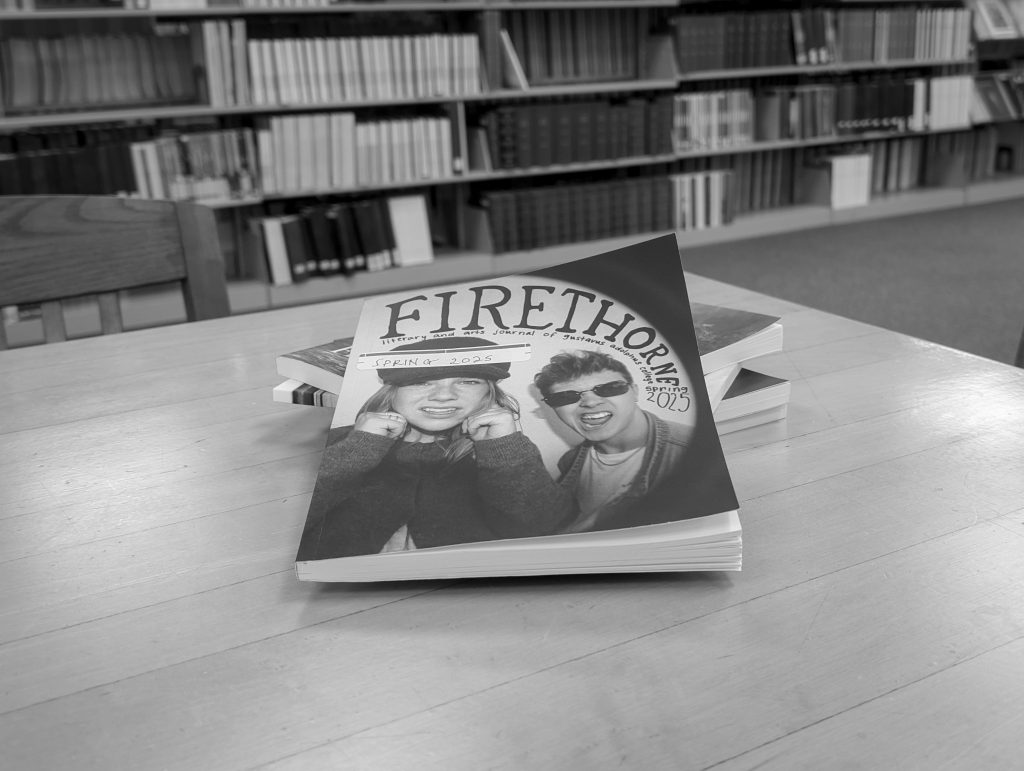
Submissions are now open to Firethorne, an annual collection of artistic works created by Gustavus students. Over a period spanning two weeks, anyone attending the college is invited to fill out an online form containing their original artwork for review and a chance to be featured in the journal’s Spring edition.
Associate English professor and editor-in-chief of Firethorne, Matthew Rasmussen, encouraged students to submit their works regardless of major.
“It can be difficult to put yourself up for judgment, but rejection is part of being a writer—or any artist. Submitting gives you a chance to share your work. You never know who will connect with it. Firethorne is a great showcase of Gustavus creativity. When students see their work in print, it’s incredibly rewarding. We publish students from all majors—political science, math, computer science, gender studies, and more,” Rasmussen said.
The journal’s editor-in-chief has held the position for seven years. Part of his portfolio includes working as an instructor in ENG 350: Editing and Publishing, a class dedicated solely to producing Firethorne. The process begins with students analyzing all submitted works and determining whether to incorporate them or not—the production phase that takes the longest.
“Once we choose what will be published, we do a ‘pinup.’ Digitally, we place each piece on a large virtual board using color‑coded notes. We look for themes and resonances—pieces that speak to each other. Then the students decide the order. It’s not alphabetical; it’s curated intentionally,” Rasmussen said.
Among the types of art commonly submitted, poetry is the most frequent. Other artforms include fiction or non-fiction prose, painting, photography, sculpture, and hybrid genres like short screenplays or scenes from plays. According to the editor-in-chief, about 20-30% of submissions make it into the final product.
“In terms of individual pieces—poems, short stories, artwork—we sometimes receive around 300 submissions. Some years it’s more, some years less. It depends on how well we get the word out. Our submission window is only two weeks because producing the journal takes a long time. We need to finish by the end of the semester and get it printed and shipped,” Rasmussen said.
The very first issue of the journal came out in 1973. Over the decades, its design has been just one of many editorial choices that have evolved with time. For example, the title did not initially include the ‘e’ at the end.
Rasmussen stressed that while having one’s work published in an official collection may be seen as a stepping stone in one’s artistic career, the same could also be said about the mere fact of having been a part of Firethorne’s production.
“Many writers get their start in literary journals. For example, I published poems in Gulf Coast, a well‑known journal from the University of Houston. That publication opened doors for me before I had a book. Literary journals are where emerging writers begin,” Rasmussen said.
“Many of my students end up in the editing and publishing class, and every issue includes students I recognize from my classes or from the Writing Center. Many have had their poetry, fiction, creative nonfiction, or artwork published in Firethorne,” Director of the Writing Center and senior continuing instructor in English Eric Vrooman said.
Vrooman commented that Gustavus has historically served as an intermediary between newcomers to the scene and the famed world of professional literary publishing as well as television and film production. He mentions names such as Lilja Sigurðardóttir, an Icelandic writer poised to visit campus on March 10th, and Gustavus alumni Chloe Radcliffe, an up-and-coming comedian in the entertainment industry.
“Her name is Lilja Sigurðardóttir. She’ll speak with us on the 10th. I read her first novel, Snare, last weekend and really enjoyed it,” Vrooman said. “Another writer visiting my fiction class is a former Gustavus student, Chloe Radcliffe, who graduated in 2009. She was a math major who worked at Target after graduation. She’s now in the latest Bradley Cooper movie, has been picked up by Amy Schumer’s agent, wrote for The Tonight Show with Jimmy Fallon, and is being asked to write a romantic comedy. She’s doing all kinds of things.”
Junior Madeleine Archer had a total of five pieces published in last year’s edition of Firethorne. They included poems, fiction, and non-fiction.
“A strong theme throughout my works was different forms of endings. Leaving your home, the end of a relationship, the death of a loved one, the person you once were that you leave behind as you change. Last year’s Firethorne submissions were probably my most raw and real works that I’ve submitted. It’s a great thing to be able to share your most meaningful work in a literary and art magazine,” Archer wrote.
Another contributor to last year’s issue was sophomore Mallory Finseth, who felt “more than happy” with the way the editorial team processed her submission. She testified that her writing proved to be a successful way of dealing with hardship. Finseth urges students with a vision or those already sitting on a piece of art to share it with the world.
“Even if it scares you. Letting a piece of yourself be seen is terrifying, believe me, I know, but it’s also incredibly rewarding. There’s something incredible about realizing your words can live beyond you,” Finseth wrote.
The deadline to submit to Firethorne’s Spring issue is Feb. 9th.