Staff Writer- Hailey Hathaway-Oxley
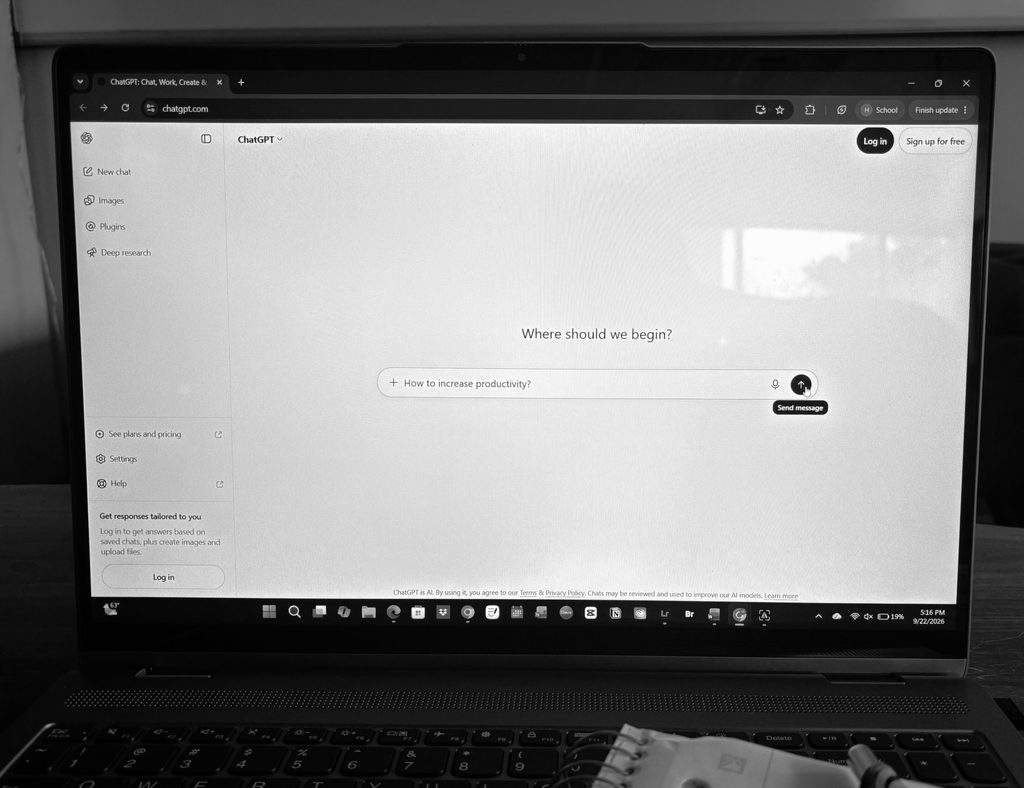
Photo Credits: Hailey Mueller
You may have heard varying arguments for or against the use of Artificial Intelligence within the college or in the workplace. It seems that the world is divided. Many are vehemently against AI, stating that it kills critical thinking by outsourcing your brain, scrapes and steals from artists and creatives, and is destroying the already precarious environment. However, there are surprisingly many on the side of AI, stating that it boosts productivity and makes mundane tasks easier, allowing students and workers to focus on hobbies and little joys that may have been pushed away due to the workload of the past. Although, with this increased productivity, there are also downsides. Scientists are calling it the “AI Productivity Paradox”, stating that, for example, if AI cuts down a task that would normally take 2 hours into 30 minutes, that instead of being expected to complete 4 tasks in an 8 hour work day, you’ll be expected to complete 16 tasks instead. In Fortune Magazine, Mike Manos, chief technology officer at Dun & Bradstreet, said his team is getting more done, faster. ‘I got the eight hours to two hours,’ he told Fortune, ‘but now I can get 20 hours of work, because the work came down … it goes back to productivity.’”
AI is just a small aspect affecting a bigger problem, something that many are calling “toxic productivity culture”, bred out of the American Dream as one “pulling themselves up by their bootstraps”, that is now taking on a new shape. This means pilates classes at 5AM and an obsessive drive to be productive. Many, including myself, constantly have an obsessive preoccupation with being productive at all costs, never feeling like what you’ve done is “enough”, continuously striving to add more to your plate, and saying that if every second of every day isn’t full, you didn’t contribute anything, or were wasting time. According to Harvard Health, on the connection of toxic productivity leading to burnout, “With toxic productivity, you’re deriving less satisfaction from the work, which is a defining feature of burnout, you’ve lost the joy of the work and the ability to engage in it in a way that seems satisfying.” Terms and phrases such as “no days off” and “sleep is for the weak” plague social media and the internet, allowing many users to spiral and strive to do more, more, and more in order to “optimize” their life.
This toxic productivity may be easy to brush off or allow to go unnoticed, noting that that’s just the way that the world and culture is, but it can negatively affect one’s mental health, to degrees of insomnia, severe anxiety and depression, and exacerbate underlying symptoms akin to OCD in many.
As a first-year at Gustavus, I have already begun to hear the term “Over-Involved Gustie”, and I myself am one who constantly throws myself into activities. I have said in the past that I constantly have to be busy, because I begin to spiral when I am left alone with my thoughts. In High School, I was involved in leadership in at least 5 separate activities, as well as balancing 2 part-time jobs, classes, and a social life. There, though, it seemed as though I was an outlier: my parents, and even peers, constantly told me that I was doing too much, and that they were worried about me over-working myself, and I shrugged it off and said that I had to in order to get into a good college and set myself up for the future.
Here at Gustavus, it is such a large part of the culture to push yourself to your limits, to join as many activities as possible, and to stay connected in the campus community, so much so that we have a term for it: “Over-Involved Gustie”. It is a term used as a badge of honor, something to be celebrated, rather than a facet pushing this productivity culture onto students. This toxic mindset is one that will most likely carry through into adulthood, jobs, and families, and you will reach retirement and have nothing to look forward to, nothing but time that you don’t have anything to fill it with, because you made no time for hobbies, no time, like Mary Oliver said, to “let the animal of your body love what it loves”.
The school has shifted language around in order to protect and change around the culture and to keep up with the times, such as calling sorority and fraternity involvement “recruitment” rather than “rush” in order to prevent language reminiscent of hazing, and even giving first-years multiple sensitivity trainings such as “Can I Kiss You?” and “You, Me, We”, and even calling first-years “first-years” instead of “freshmen” due to this same positive, anti-hazing culture. The school pushes this ideal so hard, even unknowingly. The past slogan of “Make your life count” has worked and continues to work to the detriment of all too many students, who may already be involved in 5 activities and have a full course load and think, “am I really doing enough?”
Spoiler alert: if you have to ask yourself, you’re probably doing too much. If you’re worried about it, you will be just fine. Some may wonder, will this ever change? Will the Over-Involved Gustie continue to grow, to be celebrated? Or will it die when too many are negatively affected by it? We might only know when the celebratory nature of the “Over-Involved Gustie” causes one too many panic attacks at your cubicle in 10 years.