Features Editor- Eric Hofer
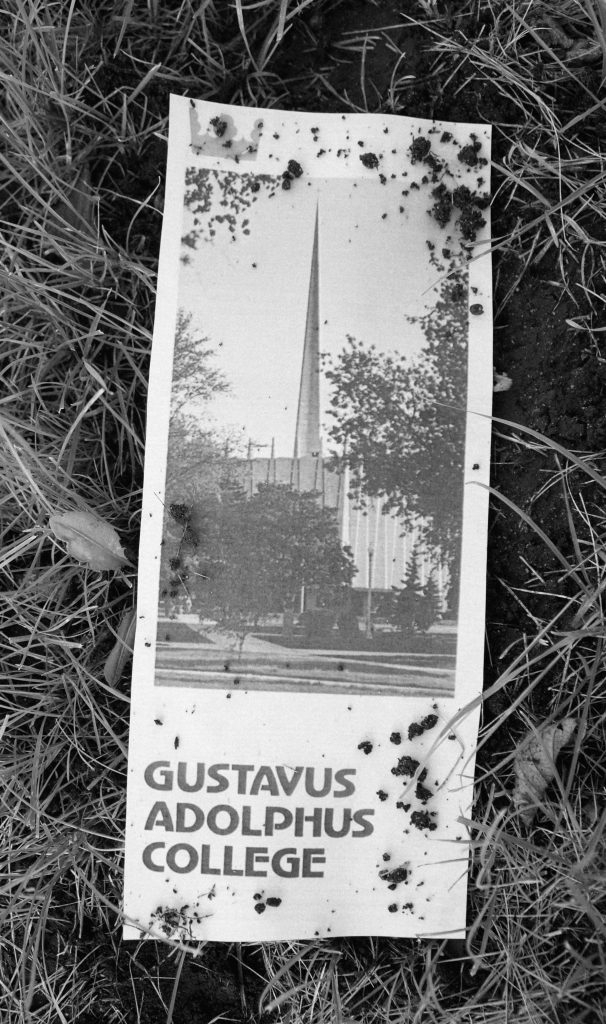
Photo credits: Anyah Moffett
Recently, archaeologists have unearthed the remains of what is believed to be an ancient civilization, which, according to translations of several ancient placards, was named Gustavus Adolphus College. Experts believe that there were once nearly 2,000 people living in these buildings, with the main focus of the settlement being on advancement of education and future career prospects.
This civilization was found atop a hill in an otherwise flat environment– this is believed to be connected to the religion that these people had. Researchers found several etchings depicting a lion, which was a common fantastical animal of the time. These etchings could be found on most unearthed artifacts and buildings, leading to the conclusion that this lion must have been some sort of deity to the people. The remains of a costume depicting the figure were also found, however, time has been unkind to them, rendering them hardly recognizable. Anthropologists believe that this costume may have been used for events and recruiting others into the civilization.
In addition to their mysterious beliefs, they managed to construct several buildings, with some citizens hardly ever needing to leave the hill until their spring exodus. The majority of these buildings are believed to have been used for the aforementioned education and acquisition of knowledge, which was a major cornerstone of the civilization. For instance, one building was dedicated to the study of science, though many of the surviving documents that were found contain information based on outdated practices of the time. Another building was seemingly where the bulk of the civilization’s economy came from, with people learning how to trade and barter with other settlements.
Though the citizens spent much of their time in these hubs of knowledge, they truly resided scattered throughout the hill in several buildings, with many of these dwellings containing two or more people in a single room, with one building containing upwards of 400 people. Due to these tight quarters, many assets were shared, such as showers and communal living spaces.
Besides the educational and residential buildings, the other most heavily trafficked building laid at the center of their civilization, with the intention of easy access to all. This location seemed to be a popular gathering spot for the locals, largely due it containing the primary spot for procuring food on the hill, one of two suppliers of caffeine– which was an incredibly popular drink amongst the citizens due to outdated beliefs it would instill them with energy– along with hosting several large events for the locals.
Near this central building is another building which once housed a plethora of different recreational activities and ways for citizens to train themselves physically. While archaeologists have yet to discover the exact reason for this besides entertainment and personal betterment, some believe that this was where the civilization’s soldiers would come to train to defend the hill from any invaders. However, until additional evidence is discovered, this theory remains unproven.
The last area of unique interest lies on the outskirts of the civilization with forests and prairies, which have since been overgrown. It’s theorized that this used to be an area of recreation for the citizens, while others believe that it may have sacred connections to the lion deity that these people worshipped. However, salvaged records show that this was one of the civilization’s largest prides.
What puzzles researchers most, however, is a yearly ritual in which the citizens fled the hill in the late spring. Strangely, this was followed only a few months later by many of the citizens returning, along with hundreds of new people. For several weeks after the move, there were records of the people forgetting how to do basic tasks around the civilization, such as forgetting where they were supposed to go or the names of people they should have remembered. Researchers have yet to find a concrete explanation for this phenomenon, but one of the leading theories is that they fled to religious reasons, possibly fearing the lion deity. Another possible explanation is that the hill is simply too close to the Sun, which while manageable during some seasons, would prove to be too much during the summer.
While there’s still much to learn about the behaviors and beliefs of this ancient civilization, many archaeologists and anthropologists are turning their focus towards this hill with aspirations of piecing together a lost legacy. Perhaps someday in the future, it’ll feel as if this civilization was never truly lost.